
Artificial intelligence has become as common as smartphones in 2026. From writing emails to designing graphics, AI tools are everywhere.
But here’s the million-dollar question: Should you stick with free AI tools or invest in budget options under $10 per month?
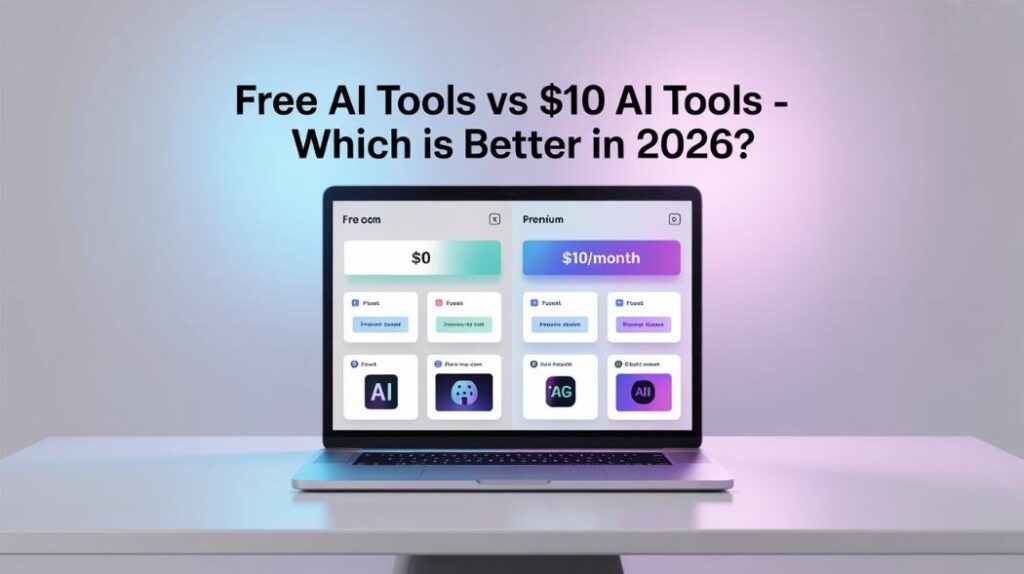
The confusion is real. With hundreds of AI platforms offering both free and paid tiers, choosing the right option feels overwhelming. Some people swear by free tools, while others claim cheap paid subscriptions changed their productivity game entirely.
The demand for affordable AI tools under $10/month has exploded because they promise professional features without breaking the bank. But are they actually better than free alternatives?
This guide cuts through the noise with a clear, practical comparison. We’ll examine real-world use cases, hidden costs, and performance differences so you can make the smartest choice for your needs and budget. Best AI tools for earning
By the end, you’ll know exactly which option is best for you.
What Are Free AI Tools?
Free AI tools are platforms that require zero financial investment. You sign up, start using them immediately, and never see a bill.
These tools have democratized access to artificial intelligence. Anyone with an internet connection can now use technology that cost millions to develop.
Popular examples include:
- ChatGPT Free (OpenAI’s conversational AI)
- Google Gemini Free (Google’s AI assistant)
- Canva Free (design platform with AI features)
- Bing AI (Microsoft’s search-integrated AI)
- Perplexity AI Free (AI research assistant)
Key characteristics of free tools:
Most free AI platforms operate on a freemium model. You get basic functionality with certain restrictions—daily usage limits, slower processing speeds, or feature caps.
Some display advertisements to monetize their free tiers. Others use the free version as a gateway, hoping users will eventually upgrade to paid plans.
The trade-off is straightforward: you sacrifice advanced features and convenience in exchange for zero cost.
📌 Important Insight: Free tools often have usage limits and fewer features, but they’re perfect for casual users and testing before committing to paid plans.
What Are AI Tools Under $10/Month?
Budget-friendly AI subscriptions sit in the sweet spot between free limitations and expensive enterprise solutions. These tools typically cost between $5 and $10 monthly.
They’re designed for individuals and small businesses who need more power than free tiers offer but can’t justify $20-$50 monthly subscriptions.
Popular examples include:
- Notion AI (~$10/month with Notion Plus)
- Microsoft Copilot ($9.99/month standalone)
- Jasper AI Starter (around $39 but often discounted)
- Rytr Unlimited (~$9/month)
- Canva Pro (frequently under $10 with annual billing)
Key features of budget paid tools:
These subscriptions unlock significantly higher usage limits. Where free versions might cap you at 10 queries daily, paid tiers often allow hundreds or even unlimited usage.
Performance improvements are noticeable. Paid users typically get priority access to servers, meaning faster response times even during peak hours.
Integration capabilities expand dramatically. Budget tools often connect with other software you’re already using—Google Workspace, Slack, or project management platforms.
📌 Insight: Paid tools offer advanced features, better performance, and customer support that free versions simply can’t match.
Key Differences: Free vs AI Tools Under $10/Month
Understanding the practical differences helps you make informed decisions. Here’s a comprehensive comparison:
| Feature | Free AI Tools | AI Tools Under $10/Month |
|---|---|---|
| Price | $0 | $5–$10/month |
| Usage Limits | Strict (10-50 queries/day) | Higher (100-1000+ queries/day) |
| Speed | Slower during peak times | Consistently faster |
| Features | Basic functionality only | Advanced features included |
| Customer Support | Community forums only | Priority email support |
| Integrations | Limited or none | Multiple platform connections |
| Security | Standard encryption | Enhanced data protection |
| Ads | Often present | Ad-free experience |
| Export Options | Limited formats | Multiple file formats |
| Updates | Delayed access | Early feature access |
The differences aren’t just cosmetic. They directly impact how efficiently you can work and what you can accomplish.
📌 Insight: Free tools may be significantly slower during peak usage hours (typically 9 AM – 5 PM EST), which can disrupt your workflow.
Pros and Cons of Free AI Tools
Advantages
✔ Absolutely Zero Cost
No credit card required, no hidden fees, no billing surprises. Free tools remove all financial barriers to entry.
✔ Perfect for Beginners
Learning AI without financial commitment lets you experiment freely. Make mistakes, test features, and explore without worry.
✔ Zero Financial Risk
Don’t like it? Simply stop using it. No subscriptions to cancel or refunds to request.
✔ Still Incredibly Powerful
Free tiers of major AI tools remain more capable than paid software from just five years ago. The baseline functionality is genuinely useful.
Disadvantages
❌ Frustrating Usage Limits
Hit your daily cap mid-project? You’re stuck waiting until tomorrow. This disrupts workflow and kills momentum.
❌ Noticeably Slower Performance
During busy hours, free tier users wait in longer queues. A 2-second response becomes 15-20 seconds.
❌ Restricted Feature Access
Advanced capabilities—custom training, API access, team collaboration—remain locked behind paywalls.
❌ Not Scalable for Business
As your needs grow, free tools become bottlenecks rather than solutions. They work for hobby projects, not client work.
📌 Insight: Free tools are best for simple tasks, learning, and beginners who aren’t relying on AI for income or critical work.
Pros and Cons of AI Tools Under $10/Month
Advantages
✔ Remarkably Affordable
At $10 monthly, you’re paying about 33 cents per day. Less than a cup of coffee for professional-grade tools.
✔ Significantly Better Performance
Priority server access means consistent speed regardless of peak hours. Your productivity stays stable.
✔ Massive Time Savings
Features like batch processing, templates, and integrations can save 5-10 hours weekly. That’s $50-$100+ in equivalent time value.
✔ Professional-Grade Output
Access to advanced features means your work looks and performs like it came from expensive tools or expert creators.
✔ Better Customer Support
When something breaks, you get actual human help instead of generic FAQ pages.
Disadvantages
❌ Monthly Financial Commitment
Even small subscriptions add up. Three $10 tools mean $30 monthly, $360 annually.
❌ Some Premium Features Still Locked
Many platforms tier their pricing. The $10 level unlocks most features, but enterprise capabilities might require $20-$50 tiers.
❌ Subscription Fatigue
Managing multiple monthly payments creates administrative overhead and potential waste if you forget what you’re paying for.
📌 Insight: Paid tools can save hours of work weekly. If you value your time at even $15/hour, saving 5 hours weekly means $75 in value from a $10 investment—a 650% ROI.
Performance Comparison: Real-World Use Cases
Theory is nice, but how do these tools actually perform when you need them? Let’s examine three common scenarios.
Content Writing and Blogging
Free Tools:
- Generate basic blog outlines
- Write simple social media posts
- Create rough first drafts
Limitations: Character limits, generic output, no SEO optimization features.
AI Tools Under $10/Month:
- Produce SEO-optimized articles with keyword integration
- Generate multiple content variations instantly
- Access to tone customization and brand voice settings
- Export directly to WordPress or other CMS platforms
Real difference: A 1,500-word article might take 60 minutes with free tools (including multiple sessions due to limits) versus 20 minutes with paid tools.
Image Generation and Design
Free Tools:
- 5-10 image generations daily
- Standard resolution outputs
- Basic templates and limited customization
AI Tools Under $10/Month:
- 50-100+ daily generations
- High-resolution and commercial-use licenses
- Advanced editing features and style consistency
- Priority rendering (no waiting in queues)
Real difference: Professional designers report completing client projects 3x faster with paid tools due to unlimited iterations and higher quality outputs.
Workflow Automation and Productivity
Free Tools:
- Manual task management
- Basic integrations (if any)
- Single-user functionality
AI Tools Under $10/Month:
- Automated workflows between apps
- Multi-platform synchronization
- Team collaboration features
- Smart scheduling and task prioritization
Real difference: Small business owners save 8-12 hours weekly by automating routine tasks—emailing, scheduling, data entry—with budget AI tools.
📌 Insight: Paid tools enable complex automation and scalability that free versions simply cannot match, making them essential for professional use.
Who Should Use Free AI Tools?
Free AI tools aren’t inferior—they’re perfect for specific users and use cases.
Best For:
Students and Learners Exploring AI capabilities without financial pressure. Perfect for homework help, research, and skill development.
Hobby Bloggers and Creators Publishing once or twice monthly? Free tools handle occasional content creation easily.
Testing and Experimentation Try before you buy. Test different AI platforms to find what works for your workflow before committing financially.
Extremely Tight Budgets When every dollar counts, free tools provide genuine value and capability at zero cost.
Ideal Use Cases:
- Brainstorming ideas and creative exploration
- Learning prompting techniques and AI fundamentals
- Basic writing assistance for personal projects
- Simple image creation for social media
- Casual automation and productivity enhancement
Free tools excel when stakes are low, deadlines are flexible, and you’re not dependent on AI for income.
Who Should Use AI Tools Under $10/Month?
Budget-friendly paid tools target a specific audience: people who need reliability and can justify the small investment.
Best For:
Freelancers and Independent Contractors When you’re billing clients, tool subscriptions are business expenses. The productivity gains directly increase earnings.
Content Creators and Bloggers Publishing multiple times weekly? You’ll hit free tier limits almost immediately. Paid tools become mandatory.
YouTubers and Video Creators Thumbnail design, script writing, and video descriptions consume lots of AI resources. Paid tiers prevent workflow disruptions.
Small Business Owners Customer service, marketing content, product descriptions—businesses generate constant AI demands that free tools can’t sustain.
Side Hustlers Building Income Streams If your side project generates even $50 monthly, a $10 tool subscription that doubles your output is profitable.
Ideal Use Cases:
- Client-facing content creation
- SEO-optimized blog management
- Regular social media marketing
- E-commerce product optimization
- Automated customer communications
- Digital product creation
The pattern is clear: anyone using AI regularly to generate income should invest in budget paid tools.
Popular AI Tools Under $10/Month Worth Considering
Not all budget AI tools deliver equal value. Here are proven options across different categories:
Writing and Content Tools
Notion AI Integrated directly into Notion’s productivity platform. Perfect for writing, organizing, and managing content all in one place.
Price: $10/month (included with Notion Plus)
Rytr Specialized for marketing copy, product descriptions, and ad content. Simple interface with strong output quality.
Price: $9/month for unlimited mode
Design and Visual Tools
Canva Pro AI-powered design features including Magic Resize, Background Remover, and template generation.
Price: Often under $10/month with annual billing or special offers
VistaCreate Alternative to Canva with strong AI features and unlimited downloads.
Price: Around $10/month
Productivity and Automation
Microsoft Copilot AI assistant integrated across Microsoft 365 apps. Works in Word, Excel, PowerPoint, and Outlook.
Price: $9.99/month standalone (or included with certain Microsoft 365 plans)
AI Chatbots and Assistants
Perplexity AI Pro AI research assistant with unlimited queries and advanced search capabilities.
Price: $20/month (occasionally discounted)
📌 Tip: Choose tools based on your specific workflow needs, not marketing hype or trending recommendations. One perfectly matched tool beats five poorly chosen ones.
Hidden Costs of Free Tools
“Free” doesn’t always mean “no cost.” Time and opportunity costs often exceed the price of budget subscriptions.
Time Cost: The Real Expense
Slower Response Times Waiting 15-30 seconds per query versus 2-3 seconds adds up fast. Over 100 daily queries, that’s 40+ minutes lost to loading screens.
Daily Limit Disruptions Hit your cap mid-project? You lose momentum, context, and focus. The mental switching cost is significant.
Feature Limitations Require Workarounds Manually doing tasks that paid tools automate consumes hours weekly. That’s unpaid labor offsetting the “free” tool.
Productivity Loss: Opportunity Cost
Slower Output Means Fewer Projects If paid tools help you complete three projects weekly instead of two, that third project’s revenue far exceeds the $10 subscription cost.
Lower Quality Output Basic features produce basic results. Clients and audiences notice the difference, potentially costing you reputation and repeat business.
Mental Energy Drain Constantly working around limitations—splitting projects to fit daily caps, tolerating slow speeds—creates cognitive load and reduces creative energy.
📌 Insight: Free tools can cost significantly more in lost time and productivity than the money saved. Always calculate total cost of ownership, not just the price tag.
ROI Comparison: Free vs Paid
Return on investment isn’t just for business tools. Even personal productivity tools should deliver value proportional to their cost.
Free Tools ROI
Investment: $0 monetary cost
Return:
- Basic functionality access
- Learning and experimentation value
- Occasional productivity boost
Break-even point: Immediate (no investment to recoup)
Best for: Users where time isn’t money—students, hobbyists, learners
AI Tools Under $10/Month ROI
Investment: $10 monthly ($120 annually)
Return:
- 5-8 hours weekly saved (260-416 hours annually)
- Faster project completion
- Higher quality outputs
- Reduced stress and frustration
Value calculation: If you value your time at just $15/hour, saving 5 hours weekly = $75 weekly value = $3,900 annually
ROI: 3,150% ($3,900 return on $120 investment)
Break-even point: After completing just 2-3 projects where the tool saves significant time
📌 Example: A freelance writer charging $100 per article who completes one extra article weekly because of tool efficiency earns an additional $5,200 annually—from a $120 tool investment.
Hybrid Strategy: The Smart Approach
You don’t have to choose sides. The smartest users combine free and paid tools strategically.
The Optimal Mix
Use Free Tools For:
- Testing new AI platforms before subscribing
- Secondary tasks with flexible deadlines
- Learning and skill development
- Backup options when primary tools are down
Use Paid Tools For:
- Primary work that generates income
- Client-facing projects with deadlines
- Tasks requiring advanced features
- Anything mission-critical to your business
Smart Progression Strategy
Phase 1: Start Free Use free tools to learn AI fundamentals, test different platforms, and identify which types of AI assist you most.
Phase 2: Strategic Upgrade Subscribe to ONE tool in your most critical category. If writing generates income, upgrade your writing AI first.
Phase 3: Measured Expansion Add paid tools one at a time as your needs and budget grow. Evaluate ROI before each new subscription.
Phase 4: Regular Audits Quarterly, review all subscriptions. Cancel anything you haven’t used in 30 days. Tool hoarding wastes money.
📌 Insight: Industry experts and successful AI users consistently recommend mixing free and paid tools rather than committing to one extreme.
Common Mistakes to Avoid
Learning from others’ mistakes saves time and money. Here are the most common pitfalls:
Buying Too Many Tools Simultaneously Subscription costs stack up fast. Start with one paid tool, master it, then consider expanding.
Ignoring Free Alternatives for Simple Tasks Don’t pay for features you don’t need. If a free tool handles a task adequately, save your money.
Paying for Unused Features Many people subscribe to “pro” tiers but only use basic functionality. Right-size your subscriptions to actual usage.
Not Testing Before Long-term Commitments Annual billing saves money but locks you in. Test monthly first, then switch to annual after confirming the tool fits your workflow.
Forgetting to Cancel Trials Set calendar reminders before free trials end. Unintended charges from forgotten trials add up quickly.
Choosing Based on Hype Instead of Need Trending tools aren’t always the best fit. Match tools to your specific workflow, not social media recommendations.
Final Verdict: Which Is Better?
The answer isn’t one-size-fits-all. It depends entirely on your situation, needs, and goals.
Short Answer:
Free AI tools are best for:
- Complete beginners learning AI
- Students and educators
- Hobby projects without deadlines
- Testing before buying
- Occasional, non-critical use
AI tools under $10/month are best for:
- Anyone earning income with AI
- Freelancers and content creators
- Small business owners
- Regular users (daily or multiple times weekly)
- People who value time over money
Final Recommendation:
The smartest approach combines both strategically:
Start with free tools. Learn the basics, test different platforms, and identify what works for you.
Upgrade when you hit limitations. If you’re consistently hitting daily caps, waiting for responses, or missing deadlines because of tool restrictions, it’s time to pay.
Calculate actual ROI. Before subscribing, estimate how much time the paid tool will save. If it saves just one hour weekly and you value your time at $15+/hour, the $10 subscription pays for itself.
Stay flexible. Your needs will change. Review subscriptions quarterly and adjust as needed.
📌 Key Insight: The real question isn’t “free vs paid”—it’s “what delivers the best return on my time and investment?” Answer that honestly based on your actual usage and goals.
FAQs
❓ Are AI tools under $10 actually worth it?
Yes, if you use them regularly for productivity or income generation. The time saved typically exceeds the cost within days. However, casual users who check AI tools once or twice weekly are better off with free versions.
❓ Can free AI tools completely replace paid ones?
For basic tasks and occasional use, absolutely. But for professional work, consistent daily use, or advanced features, free tools hit limitations quickly. Think of it like the difference between a bicycle and a car—both get you there, but speed and capacity differ significantly.
❓ What’s the best strategy for someone just starting?
Use a mix approach. Start with free versions of 2-3 different AI categories (writing, design, automation). After 30 days, upgrade the ONE tool you used most frequently. Expand gradually based on actual usage patterns, not anticipated needs.
❓ Which is best for complete beginners?
Free tools are ideal for beginners. They remove financial pressure while you learn prompting, explore capabilities, and figure out which AI categories matter most to your work. Upgrade only after you’ve established consistent usage patterns.
❓ How do I know when it’s time to upgrade?
Three clear signals: (1) You’re hitting daily usage limits multiple times weekly, (2) Tool slowness is disrupting your workflow and missing deadlines, or (3) You’re manually doing tasks that paid features would automate. Any one of these justifies upgrading.
Conclusion
The free versus paid debate isn’t about finding a universal winner. It’s about matching tools to your specific situation.
Free AI tools have revolutionized access to technology. Millions now use sophisticated AI capabilities at zero cost—something unimaginable just years ago. For learners, students, and casual users, free tiers provide genuine, substantial value.
Budget AI tools under $10/month serve a different purpose. They’re productivity multipliers for people who rely on AI regularly. The modest investment unlocks speed, reliability, and advanced features that directly translate to time savings and better output.
The smartest approach? Start small, measure results, and scale strategically. Use free tools until they limit you, then upgrade thoughtfully based on demonstrated need rather than fear of missing out.
Your AI toolkit should evolve with your skills and needs. What works today might need adjustment in six months, and that’s completely fine.
Choose tools based on your actual goals and usage patterns, not trends or marketing messages. Let results, not hype, guide your decisions.
Ready to find your perfect AI tool mix? Start by identifying your single most important AI use case, then test both free and budget paid options for 30 days. Track time saved and quality improvements—let data drive your decision.
