
The Race to Sound Human
AI assistants have come a long way—and in 2026, the competition is no longer just about who’s smarter. It’s about who feels more human.
Millions of people across the US, UK, Canada, and Australia now use AI tools every single day—for writing, coding, research, and even emotional support. Two names dominate the conversation: ChatGPT by OpenAI and Claude by Anthropic.
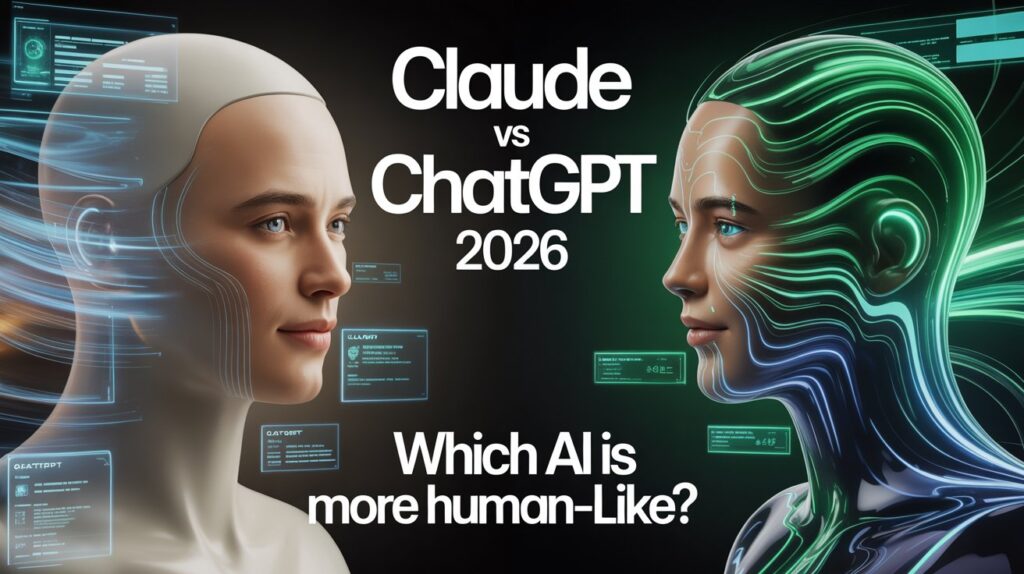
Both are powerful. Both are intelligent. But here’s the question most people are quietly asking:
Which AI actually sounds more natural, emotional, and human-like?
In this article, you’ll get a clear, honest breakdown of:
- Core features of each AI
- Writing quality and tone comparison
- Emotional intelligence and conversation style
- Coding, creativity, and multimodal capabilities
- A final verdict on which AI feels more human in 2026
Let’s get into it.
What Is ChatGPT? (2026 Overview)
ChatGPT is developed by OpenAI and powered by the GPT-5 series of models. It has evolved into one of the most versatile AI platforms available today.
Key Features:
- Multimodal capabilities — handles text, images, voice, and video
- Custom GPTs — build your own AI persona for specific tasks
- Advanced voice mode — near-real-time voice conversations
- Plugin and agent ecosystem — connect to external apps and automate workflows
Best suited for:
- General users who want a do-everything AI
- Content creators producing scripts, blogs, and social media
- Business owners automating customer service and operations
Why ChatGPT Feels Human
ChatGPT has a naturally expressive tone. It uses humor, shifts its register based on context, and even mirrors a user’s energy. The memory feature lets it remember your preferences across sessions—making it feel less like a tool and more like an ongoing conversation partner.
It tells jokes. It pushes back occasionally. It engages. That personality-forward approach is a big reason why millions of users feel a personal connection to it.
What Is Claude AI? (2026 Overview)
Claude is developed by Anthropic, a safety-focused AI company. The current flagship models—Claude Opus 4.6 and Claude Sonnet 4.6—are built with a deep emphasis on reasoning, safety, and nuanced language understanding.
Key Features:
- Massive context window — processes up to 1 million tokens, ideal for long documents
- Constitutional AI framework — designed to be honest, harmless, and helpful
- Structured thinking — exceptional at breaking down complex problems
- Superior long-form writing — produces clean, essay-quality text
Best suited for:
- Writers and editors who need clean, natural prose
- Developers working on complex coding tasks
- Researchers analyzing lengthy papers or datasets
Genesis AI Review 2026
Why Claude Feels Human
Claude doesn’t try to impress you. It thinks before it responds. Its tone is calm, measured, and genuinely reflective—much closer to how a thoughtful person writes an email or explains a concept.
Where ChatGPT entertains, Claude reasons. That subtle difference is what makes Claude’s writing feel more like something a real person would produce.
Claude vs ChatGPT 2026: Quick Comparison Table
| Feature | ChatGPT | Claude |
|---|---|---|
| Developer | OpenAI | Anthropic |
| Core Strength | Multimodal AI | Deep reasoning |
| Human-like Writing | Very good | Excellent |
| Context Window | High | Extremely high (1M tokens) |
| Coding | Strong | Superior for developers |
| Creativity | High | More structured |
| Image Generation | Yes | No |
| Ease of Use | Beginner-friendly | Slightly advanced |
| Emotional Tone | Expressive | Thoughtful |
Human-Like Writing Comparison
This is where the two AIs differ most noticeably.
ChatGPT Writing Style
ChatGPT produces content that’s engaging and easy to read. It flows naturally, uses varied sentence lengths, and often adds a casual warmth that makes it feel relatable.
However, it can occasionally lean toward being verbose—adding extra sentences where a sharper edit would serve the reader better. It’s great for storytelling, social copy, and scripts.
Claude Writing Style
Claude writes the way a careful human writer would. Its sentences are purposeful. Its structure is logical. There’s a clarity and restraint to Claude’s prose that makes it feel authored rather than generated.
For blog articles, research summaries, and professional reports, Claude consistently produces text that reads as though a skilled human wrote it—without over-explaining or padding.
The bottom line: Claude edges ahead for written content quality. ChatGPT is more engaging in casual or creative contexts.
Conversation & Emotional Intelligence
ChatGPT
ChatGPT leans into personality. It uses emojis when appropriate, matches your tone, and adapts to whether you want a quick answer or a deep discussion. Talking to it genuinely feels like chatting with a knowledgeable friend.
It also handles emotional topics with sensitivity—offering support, reframing difficult thoughts, and maintaining warmth throughout a conversation.
Claude
Claude takes a different approach. It’s calm and grounded. It doesn’t perform enthusiasm—instead, it engages with genuine depth. For serious conversations—mental health discussions, difficult decisions, philosophical questions—Claude’s measured tone often feels more appropriate and trustworthy.
Key Takeaway:
- ChatGPT = the expressive, sociable human
- Claude = the thoughtful, considered human
Neither is wrong. They’re just different kinds of human.
Coding & Problem-Solving Ability
Both AIs are capable developers’ assistants, but they approach code differently.
Claude excels at:
- Writing precise, minimal, production-ready code
- Understanding large codebases in a single context window
- Debugging complex logic without unnecessary explanation
ChatGPT excels at:
- Walking beginners through code step by step
- Explaining concepts in plain English alongside the solution
- Handling diverse programming tasks across many languages
For experienced developers who want clean output with minimal hand-holding, Claude is the stronger choice. For someone learning to code or needing detailed explanations, ChatGPT is more accessible.
Multimodal Capabilities: A Big Difference
This is one area where ChatGPT clearly leads.
ChatGPT (2026):
- Generates and analyzes images using DALL·E integration
- Processes audio and video input
- Powers AI agents that interact with external apps
- Creates content across multiple formats in a single workflow
Claude (2026):
- Primarily text-based
- No native image or video generation
- Focused entirely on language and reasoning tasks
If your workflow involves visual content creation, video scripts with image mockups, or voice-based interaction, ChatGPT is the more complete platform.
Verdict: ChatGPT wins on multimodal features.
Context & Memory: Long Conversations
If you work with large documents or lengthy conversations, this section matters a lot.
Claude’s 1 million token context window is a significant advantage. It can read and reason over:
- Entire books or research papers
- Long legal contracts
- Complex multi-document projects
You don’t need to paste content in chunks or summarize—Claude holds the whole picture.
ChatGPT has strong memory features and is better at personalizing over time—remembering your name, preferences, and past projects across sessions. It creates a sense of ongoing relationship.
Summary: Claude handles large single-session documents better. ChatGPT offers better long-term personalization across sessions.
Pricing & Usage Limits (2026)
| Plan | ChatGPT | Claude |
|---|---|---|
| Free Tier | Available, limited | Available, more restricted |
| Paid Plans | Plus, Pro (high limits) | Pro (moderate limits) |
| Message Limits | ~160 messages / 3 hours | ~45 messages / 5 hours |
| Accessibility | Broader | More limited on free tier |
For everyday users who don’t want to think about limits, ChatGPT’s free and paid tiers offer more generous access.
Claude’s power users tend to be professionals who subscribe specifically for advanced writing and coding tasks—where quality matters more than volume.
Verdict: ChatGPT offers better value accessibility for most users.
Pros and Cons at a Glance
✅ ChatGPT Pros
- All-in-one AI platform (text, image, voice, video)
- Expressive and engaging personality
- Beginner-friendly with excellent tutorials and community support
- Better usage limits on free and paid plans
❌ ChatGPT Cons
- Can occasionally produce verbose or padded responses
- Large ecosystem can feel overwhelming for new users
✅ Claude Pros
- Most human-like writing quality of any AI in 2026
- Exceptional long-form reasoning and document analysis
- Best-in-class coding output for professional developers
- Calm, trustworthy tone for sensitive or complex topics
❌ Claude Cons
- No native image or video generation
- More restrictive usage limits on lower-tier plans
- Less personality-driven—can feel subdued in casual chats
Real-World Use Cases: Which AI Should You Use?
| Use Case | Best AI |
|---|---|
| Blog Writing | Claude |
| YouTube Scripts | ChatGPT |
| Coding Projects | Claude |
| Marketing Copy | ChatGPT |
| Academic Research | Claude |
| Workflow Automation | ChatGPT |
| Legal Document Review | Claude |
| Social Media Content | ChatGPT |
Pro tip: Many professionals use both tools. They draft and reason with Claude, then polish and publish using ChatGPT’s creative edge. It’s not always an either/or decision.
Which AI Feels More Human in 2026? (The Main Answer)
After a thorough comparison, here’s the honest verdict:
Claude wins when it comes to:
- Natural, unforced writing quality
- Logical and structured thinking
- Producing text that reads as authentically human-authored
- Handling nuanced, serious, or complex topics with care
ChatGPT wins when it comes to:
- Personality, humor, and emotional expressiveness
- Real-world interaction—voice, images, and agents
- Accessibility and ease of use for everyday tasks
- Long-term memory and personalization
📌 Final Verdict
If “human-like writing” is your priority → Choose Claude
If “human-like interaction” is your goal → Choose ChatGPT
Both are extraordinary tools. Your best choice depends entirely on what you need the AI to do for you.
The Future of AI: 2026 and Beyond
The gap between AI and human communication is closing rapidly. In the next few years, expect:
- Emotional intelligence improvements — AI that understands context, mood, and intent at a deeper level
- Hyper-personalization — AI that adapts its communication style to individual users over time
- AI agents — autonomous assistants that take actions, not just answer questions
- Real-time assistance — seamlessly integrated into work, health, education, and daily life
Both ChatGPT and Claude are actively moving in this direction. The question won’t be “which AI is more human?” — it’ll be “how do we use them responsibly?”
Frequently Asked Questions (FAQs)
Q1. Is Claude better than ChatGPT in 2026?
It depends on the task. Claude is stronger for writing, reasoning, and document analysis. ChatGPT is the better all-round tool for general users, creative projects, and multimodal tasks.
Q2. Which AI is more human-like?
Claude produces more naturally human-sounding written content. ChatGPT feels more human in live conversation—its personality, tone variation, and humor make interactions feel social and dynamic.
Q3. Can Claude replace ChatGPT?
Not fully. Claude is a specialist that excels in specific areas. ChatGPT is a generalist that handles a broader range of tasks. Many users benefit from using both.
Q4. Which AI is best for beginners?
ChatGPT. Its interface is intuitive, its responses are engaging, and its large community means help and tutorials are always available.
Q5. Which AI is better for professional writing?
Claude. Its prose is cleaner, more logical, and less prone to filler. Professional writers, researchers, and developers consistently rate it higher for output quality.
Conclusion: Two AIs, Two Strengths
In 2026, both ChatGPT and Claude represent the cutting edge of what AI can do—and both have legitimate claims to being “human-like,” just in different ways.
ChatGPT is the AI that talks like a human—expressive, funny, and endlessly engaging.
Claude is the AI that writes like a human—thoughtful, clear, and genuinely intelligent in its output.
There’s no single winner. There’s only the right tool for the job.
- Writers and researchers → Start with Claude
- Content creators and marketers → Start with ChatGPT
- Power users → Use both, and build a workflow around each one’s strengths
The best move in 2026? Don’t pick sides. Pick the right tool for each task—and watch your productivity soar.
Disclaimer: AI capabilities and pricing are subject to change. Always check official product pages for the most current information.
