
Every day, businesses receive hundreds of customer inquiries across websites, social media, email, and messaging apps. Responding to each message manually is not only time-consuming but also expensive and inefficient.
This is where AI bots for business come into play.
AI-powered bots are transforming how companies handle customer interactions. These intelligent tools automate sales conversations, answer support questions, qualify leads, and provide 24/7 assistance without requiring constant human intervention.
Unlike traditional chatbots that follow rigid scripts, modern AI bots use natural language processing and machine learning to understand context, handle complex questions, and deliver personalized responses. They work seamlessly across multiple channels including websites, WhatsApp, Facebook Messenger, Instagram, email, and even voice calls.
The business impact is significant. Companies using AI bots report faster response times, reduced support costs, higher conversion rates, and improved customer satisfaction. A customer service team that once needed 10 people to handle inquiries can now operate with 3-4 staff members, while the AI handles routine questions and qualifies leads automatically.
Why businesses are adopting AI bots:
- Instant responses: Customers get answers immediately, not after waiting hours or days
- Cost reduction: Automated conversations reduce the need for large support teams
- Better customer experience: Consistent, accurate answers available round-the-clock
- Increased sales: Bots qualify leads and guide prospects through the buying journey
- Scalability: Handle thousands of conversations simultaneously without additional staff
AI customer service agents can manage conversations across chat, email, voice, and other channels using large language models. This allows them to understand context, remember previous interactions, and respond naturally like human agents.
In this comprehensive guide, you’ll discover the 11 best AI bots for business in 2026. We’ll cover their key features, pricing structures, pros and cons, and ideal use cases to help you choose the right automation tool for your specific needs.
Whether you’re a small business owner looking to automate customer support or an enterprise seeking advanced sales automation, this review will guide you toward the perfect AI bot solution.
What Are AI Bots for Business?
AI bots for business are sophisticated software applications powered by artificial intelligence that automate interactions with customers, leads, and website visitors. Unlike simple chatbots that can only respond to predefined keywords, modern AI bots understand natural language, learn from conversations, and handle complex queries intelligently.
These bots serve as virtual assistants that represent your business 24/7, engaging with customers the moment they reach out without requiring immediate human intervention.
How AI Bots Work
The technology behind business AI bots combines several advanced capabilities:
Natural Language Processing (NLP): This allows bots to understand human language in context. Instead of just matching keywords, NLP enables bots to grasp intent, sentiment, and meaning behind customer messages.
Machine Learning: AI bots improve over time by analyzing successful conversations and learning from human agent interactions. They become smarter and more accurate as they handle more queries.
Conversation Automation: Bots follow intelligent workflows that guide conversations toward specific outcomes—whether that’s solving a problem, scheduling a meeting, or closing a sale.
Knowledge Base Integration: Advanced AI bots connect to your company’s knowledge base, help documentation, and CRM system to provide accurate, contextual answers.
Types of Business AI Bots
Different bots serve different business functions:
Customer Support Bots: Handle common questions, troubleshoot issues, and escalate complex problems to human agents. They reduce support ticket volume and provide instant help.
Sales Bots: Engage website visitors, qualify leads by asking relevant questions, schedule sales calls, and guide prospects through the buying process.
Lead Generation Bots: Capture visitor information, segment leads based on responses, and automatically add qualified prospects to your CRM.
Marketing Automation Bots: Send targeted messages, promote products, gather feedback, and nurture leads through personalized conversation sequences.
Voice AI Agents: Handle phone calls, answer questions verbally, route calls to appropriate departments, and provide voice-based customer service.
Example Tasks AI Bots Automate
The practical applications of AI bots span across every customer touchpoint:
- Answering frequently asked questions instantly
- Qualifying leads by asking discovery questions
- Booking meetings and appointments automatically
- Processing refund requests and order tracking
- Providing product recommendations based on customer needs
- Collecting customer feedback and survey responses
- Onboarding new users with step-by-step guidance
- Sending proactive notifications about orders, updates, or promotions
AI-powered chatbots can analyze user intent, answer complex multi-part questions, and guide prospects through the sales funnel automatically—all without human involvement until absolutely necessary.
The result is a business that operates more efficiently, responds faster, and scales customer interactions without proportionally increasing staff costs.
Why Businesses Need AI Bots in 2026
The business landscape has evolved dramatically. Customer expectations have shifted from “response within 24 hours” to “instant answers, right now.” AI bots have become essential tools for meeting these demands while controlling costs.
1. 24/7 Customer Support
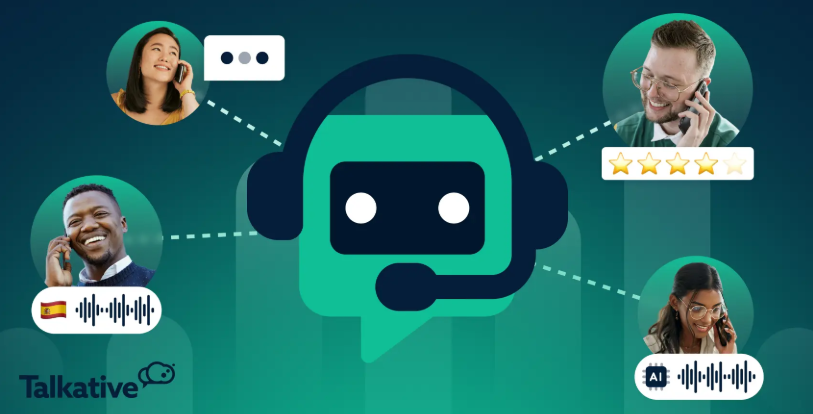
Customers no longer respect business hours. They expect help at 2 AM, on weekends, and during holidays. Human teams can’t realistically provide round-the-clock coverage without massive expense.
AI bots solve this problem completely. They never sleep, never take breaks, and handle unlimited conversations simultaneously. A customer in Australia gets the same instant support as someone in New York, regardless of time zones.
This constant availability dramatically improves customer satisfaction scores and prevents lost sales from unanswered inquiries.
2. Automated Lead Generation
Every website visitor represents a potential customer, but most businesses lose 70-80% of leads simply because they don’t capture information fast enough or engage effectively.
AI sales bots proactively engage visitors, ask qualifying questions, and capture contact details while interest is highest. They identify high-intent prospects and route them directly to sales teams while nurturing lower-intent visitors with automated follow-up sequences.
The result? More leads, better quality prospects, and higher conversion rates.
3. Increased Conversion Rates
Speed matters in sales. Research shows that responding to a lead within 5 minutes versus 30 minutes increases conversion rates by 400%. AI bots respond instantly, every time.
They guide prospects through decision-making, answer objections immediately, and remove friction from the buying process. This acceleration of the sales cycle directly impacts revenue.
4. Reduced Operational Costs
Hiring, training, and maintaining customer support teams is expensive. The average customer service representative costs $40,000-50,000 annually, not including benefits, office space, and management overhead.
AI bots handle 60-80% of routine inquiries automatically, allowing businesses to operate with smaller human teams focused on complex, high-value interactions. The cost savings are substantial—often reducing support expenses by 40-60% while maintaining or improving service quality.
5. Improved Customer Experience
Modern customers value convenience above almost everything else. They prefer quick, accurate self-service over waiting for human agents.
AI bots provide instant, consistent answers. They never have bad days, never forget information, and always follow best practices. Customers get uniform, high-quality service regardless of when they reach out or which channel they use.
Real Example: Many businesses use AI agents to automate sales conversations and qualify leads before sending them to human teams. These bots handle product questions, recommend items based on preferences, and even process simple transactions—increasing sales while reducing the burden on support staff.
Customer satisfaction scores for AI-assisted support often match or exceed traditional human-only support, primarily because response speed and consistency matter more to most customers than speaking with a human.
The Competitive Advantage
In 2026, AI bots are no longer optional for competitive businesses. Companies that haven’t implemented automation find themselves at a significant disadvantage:
- Slower response times lead to lost leads
- Higher operational costs reduce profit margins
- Limited support hours frustrate customers
- Inconsistent service quality damages reputation
AI bots for business have shifted from “nice to have” to “must have” for any company serious about growth and efficiency.
Best Free AI Tools for Freelancers in 2026 (Tested List)
How We Selected the Best AI Bots for Business
Choosing the right AI bot platform requires careful evaluation. We tested over 30 business automation tools and selected the top 11 based on specific criteria that matter most to real businesses.
Our Evaluation Criteria:
Automation Features: How intelligently does the bot handle conversations? Can it understand context, handle multi-step workflows, and provide accurate answers?
Integration Capabilities: Does it connect seamlessly with CRM systems, email platforms, help desks, and other business tools you already use?
AI Intelligence: How sophisticated is the natural language processing? Can the bot learn from conversations and improve over time?
Pricing Structure: Is the cost reasonable for the value provided? Are there hidden fees or strict usage limits?
Scalability: Will the platform grow with your business? Can it handle increasing conversation volumes without performance degradation?
Ease of Use: Can non-technical team members build and manage bots without developer help?
Channel Support: Does it work across websites, mobile apps, social media, WhatsApp, email, and other channels your customers use?
We prioritized tools that deliver real business value—measurable improvements in conversion rates, support efficiency, and customer satisfaction—rather than just impressive technology demos.
Quick Comparison Table
| Tool | Best For | Starting Price | Key AI Features | Free Plan |
|---|---|---|---|---|
| Intercom | Customer support automation | $74/month | AI chatbot + helpdesk + automation | Trial only |
| Drift | Sales automation & conversions | $2,500/month | AI sales bot + meeting scheduling | No |
| Tidio | Small businesses & ecommerce | $29/month | Lyro AI + live chat | Yes (limited) |
| ManyChat | Social media automation | Free – $15/month | Messenger + Instagram DM bots | Yes |
| Chatfuel | Facebook marketing automation | $14.99/month | Chatbot marketing + broadcasts | Yes (limited) |
| HubSpot Chatbot | CRM integration & lead gen | Free – $800/month | AI lead capture + routing | Yes |
| Freshchat | Omnichannel support | $15/month | AI responses + unified inbox | Trial only |
| Ada | Enterprise support automation | Custom pricing | Multilingual AI + self-service | No |
| Landbot | Conversational landing pages | $40/month | No-code builder + WhatsApp | Trial only |
| Botpress | Customizable developer bots | Free – $595/month | Open-source + custom AI | Yes |
| ChatBot.com | Sales chatbot & lead routing | $52/month | AI conversations + integration | Trial only |
This comparison provides a quick reference, but each tool has unique strengths suited to specific business needs. Let’s explore each platform in detail.
11 Best AI Bots for Business
Tool #1 – Intercom AI
Overview
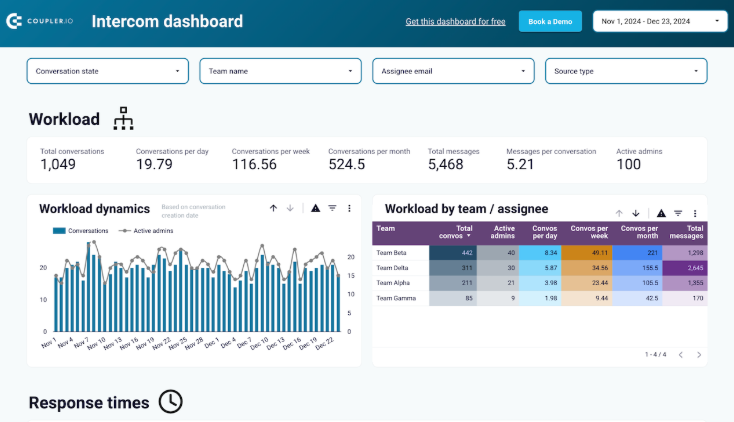
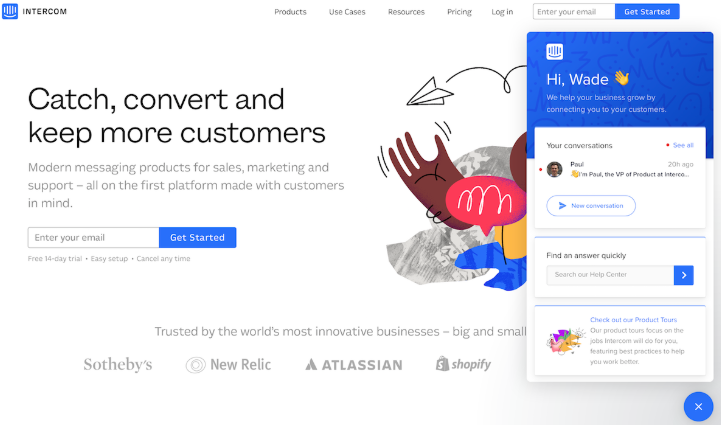
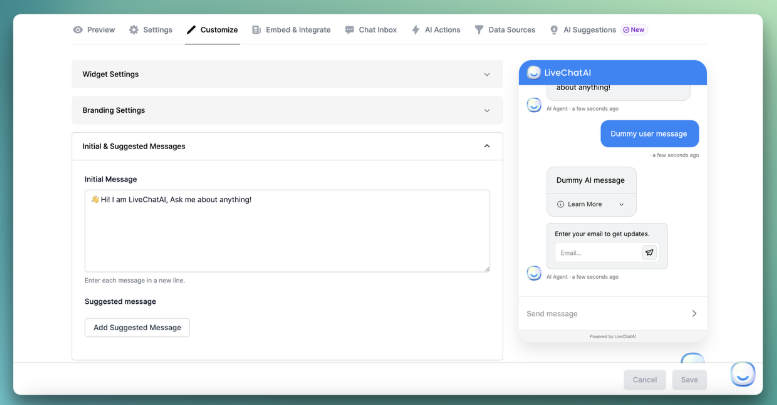
Intercom has established itself as one of the most comprehensive customer communication platforms, combining AI chatbots, live chat, help desk, and customer data tools in a unified system. Their AI-powered Resolution Bot handles common support questions automatically while seamlessly escalating complex issues to human agents.
Key Features
AI Customer Support Automation: Intercom’s Resolution Bot uses machine learning to answer repetitive questions by pulling information from your knowledge base and past conversation data. It improves accuracy over time as it learns from agent interactions.
Conversation Routing: Intelligent routing sends conversations to the right team or agent based on customer intent, urgency, and historical context.
Knowledge Base Integration: The AI automatically searches your help documentation to provide accurate answers without manual programming.
Proactive Messaging: Send targeted messages to users based on behavior, triggering helpful conversations at the right moment in the customer journey.
Custom Bots Builder: Create specialized bots for specific workflows like lead qualification, product tours, or feedback collection using their visual bot builder.
Rich Analytics: Detailed reporting shows bot performance, resolution rates, conversation volumes, and customer satisfaction scores.
Pros
- Extremely powerful automation capabilities suitable for complex support needs
- Seamless integration between bot, live chat, and ticketing system
- Excellent for teams transitioning from human-only support to AI-assisted
- Strong mobile apps for managing conversations on the go
- High-quality UI and user experience
Cons
- Premium pricing puts it out of reach for many small businesses
- Can be complex to set up initially, requiring significant configuration
- Some features locked behind higher-tier plans
- Occasional learning curve for non-technical team members
Pricing
Starts at $74/month for basic features, with advanced AI capabilities requiring higher-tier plans starting at $395/month. Enterprise pricing available for large organizations.
Best For
Mid-sized to enterprise businesses with substantial support volumes who need sophisticated automation while maintaining human touch. Ideal for SaaS companies, tech startups, and businesses with complex product offerings.
Tool #2 – Drift (AI Sales Bot)
Overview
Drift pioneered conversational marketing and remains the leader in AI-powered sales automation. Unlike support-focused bots, Drift is specifically designed to capture and qualify leads automatically through website conversations, then route high-intent prospects directly to sales representatives.
Key Features
Conversational Sales: Drift’s AI engages website visitors immediately, asking qualification questions and identifying buying intent in real-time.
Intelligent Meeting Scheduling: Automatically books meetings with sales reps based on availability, prospect fit, and routing rules—no back-and-forth email required.
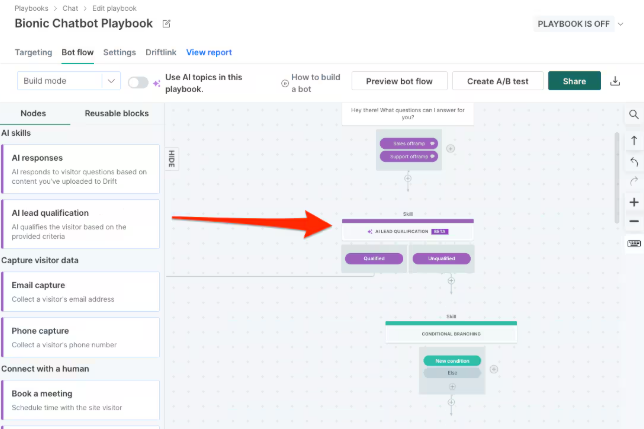
Lead Qualification: The bot asks discovery questions to score leads and prioritize those most likely to convert.
Revenue Acceleration: Routes qualified prospects to sales team members instantly via Slack notifications or direct calls, minimizing response time.
Account-Based Marketing Integration: Identifies visitors from target accounts and triggers personalized conversation flows.
Live Chat Takeover: Sales reps can jump into bot conversations at any moment to close deals personally.
Pros
- Laser-focused on revenue generation and sales acceleration
- Extremely effective at reducing time from visitor to qualified lead
- Powerful integrations with Salesforce, HubSpot, and other CRMs
- Proven track record of increasing conversion rates by 2-3x for B2B companies
- Excellent reporting on pipeline attribution
Cons
- Very expensive compared to general-purpose chatbots
- Overkill for businesses not focused on lead generation
- Requires dedicated sales team to handle qualified leads
- Limited customer support features
Pricing
Premium pricing starts at $2,500/month for small teams, scaling upward based on conversation volume and features. Custom enterprise pricing available.
Best For
B2B companies with high-value deals where lead quality and speed matter more than cost. Perfect for SaaS sales teams, consulting firms, and businesses with dedicated sales development representatives.
Drift is designed mainly for capturing and qualifying leads automatically through website conversations, making it the gold standard for sales-focused AI automation.
Tool #3 – Tidio AI
Overview
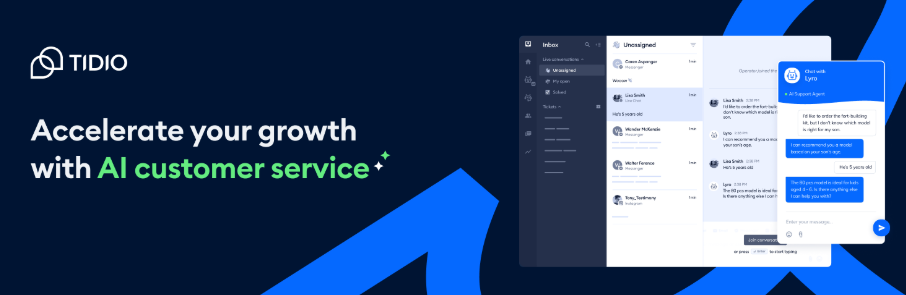
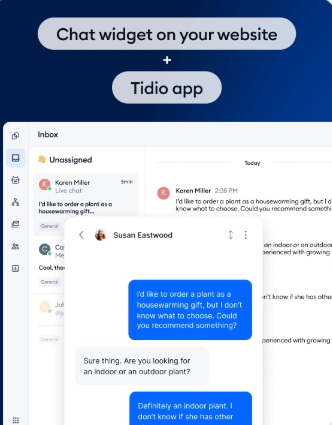
Tidio offers an accessible entry point into AI automation for small businesses and e-commerce stores. Their Lyro AI bot handles customer questions while their live chat system allows human agents to step in when needed. The platform balances automation with affordability.
Key Features
Lyro AI Agent: Tidio’s proprietary AI understands customer intent and provides personalized responses based on your website content and product catalog.
Live Chat + Chatbot Hybrid: Seamlessly switches between AI automation and human agents, ensuring customers always get help.
E-commerce Integrations: Direct connections to Shopify, WooCommerce, and other platforms enable product recommendations and order tracking.
Pre-built Templates: Dozens of chatbot templates for common scenarios like abandoned cart recovery, lead generation, and customer support.
Multichannel Support: Manage conversations from website, email, Messenger, and Instagram in one inbox.
Order Status Automation: Customers can check order status, track shipments, and get delivery updates through the bot.
Pros
- Very affordable for small businesses and startups
- Quick setup with minimal technical knowledge required
- Strong e-commerce features for online stores
- Free plan available for basic usage
- Clean, intuitive interface
Cons
- AI capabilities less sophisticated than premium platforms
- Limited customization for complex workflows
- Conversation volume limits on lower-tier plans
- Analytics less detailed than enterprise solutions
Pricing
Free plan available with limited features. Paid plans start at $29/month for the Communicator plan. Lyro AI add-on costs additional $39/month.
Best For
Small to medium e-commerce businesses, online stores, and startups looking for affordable automation. Ideal for businesses receiving 50-500 customer inquiries monthly.
Tidio combines live chat with AI automation and offers chatbot templates for lead generation, making it perfect for businesses transitioning from manual support to automated systems.
Tool #4 – ManyChat
Overview
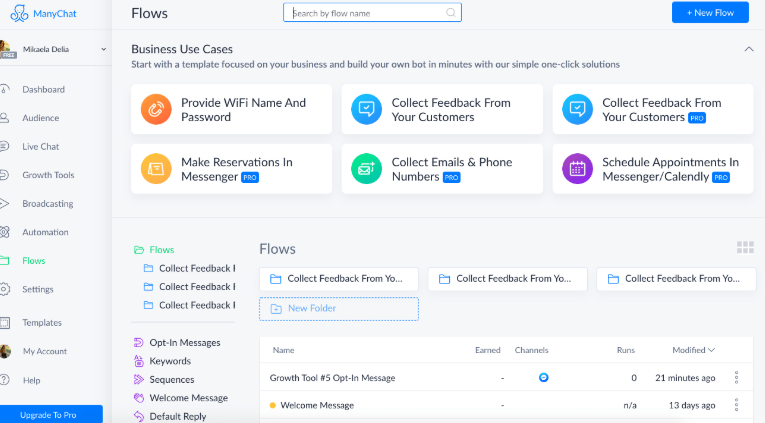
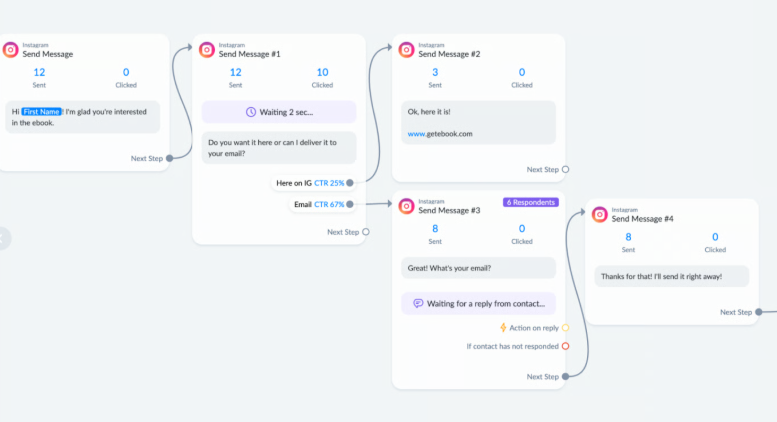
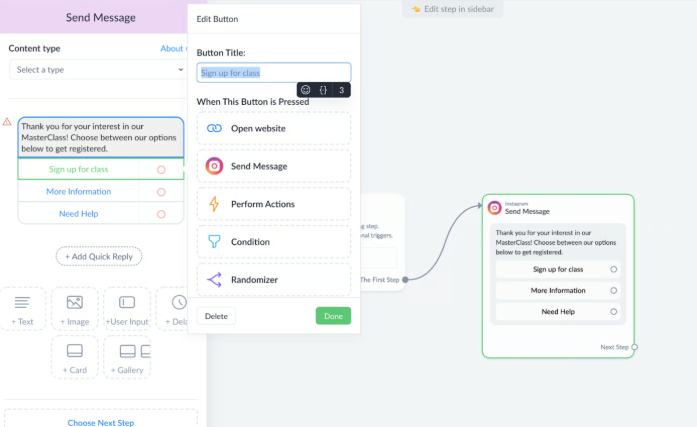
ManyChat dominates social media automation, specializing in Facebook Messenger and Instagram DM bots. It enables businesses to automate marketing conversations, capture leads, and nurture prospects directly within social platforms where audiences already spend their time.
Key Features
Messenger Automation: Build automated conversation flows for Facebook Messenger that engage followers, answer questions, and drive sales.
Instagram DM Automation: Create bots that respond to Instagram Story mentions, comments, and direct messages automatically.
Marketing Automation: Send broadcast messages, promotional campaigns, and personalized sequences to your subscriber list.
Comment Guard: Automatically respond to comments on your posts with personalized messages or offers.
E-commerce Integration: Connect to Shopify and send order updates, abandoned cart reminders, and product recommendations.
Growth Tools: Capture leads through Messenger pop-ups, landing pages, and QR codes that start automated conversations.
Pros
- Best-in-class social media automation
- Very user-friendly visual bot builder
- Generous free plan for up to 1,000 contacts
- Excellent deliverability rates on Messenger
- Strong community and learning resources
Cons
- Limited to Meta platforms (Facebook, Instagram)
- Cannot handle complex customer support scenarios
- Messenger engagement rates declining compared to peak years
- No voice or SMS capabilities
Pricing
Free plan for up to 1,000 contacts. Pro plan starts at $15/month, scaling based on contact count.
Best For
Social media-focused businesses, influencers, e-commerce brands, and content creators who engage audiences primarily through Facebook and Instagram. Perfect for businesses building community through social platforms.
Tool #5 – Chatfuel
Overview
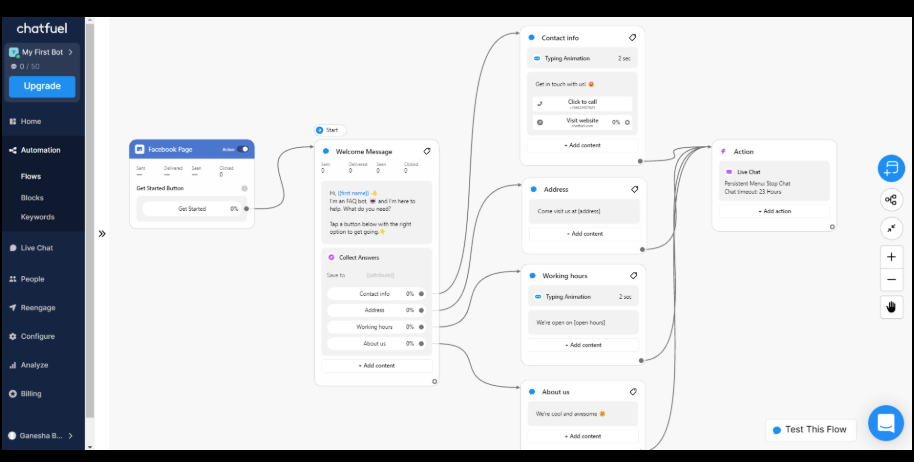
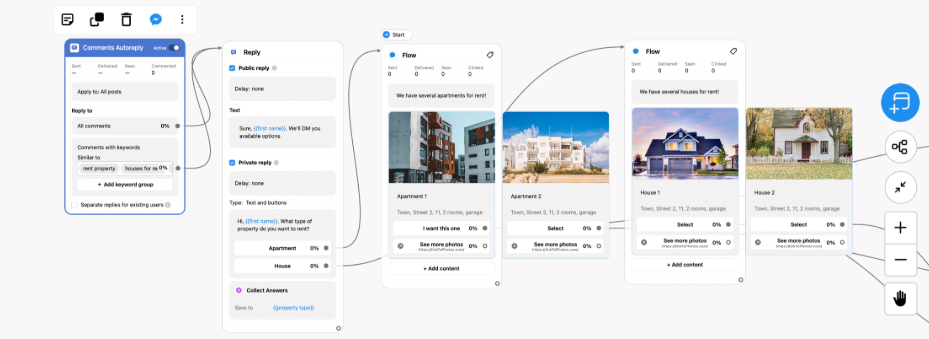
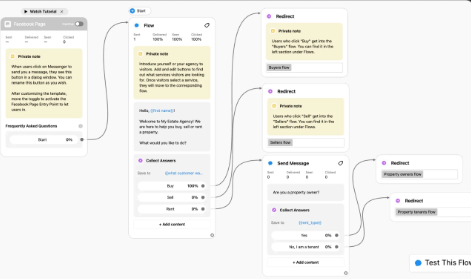
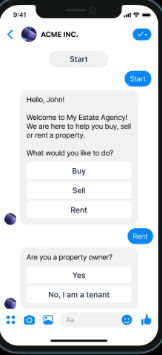
Chatfuel specializes in Facebook Messenger marketing automation, helping businesses build audiences, automate conversations, and drive sales through Meta’s messaging platform. It’s particularly strong for e-commerce and content businesses.
Key Features
Facebook Chatbot Builder: No-code visual builder creates sophisticated Messenger bots without programming knowledge.
E-commerce Automation: Product catalogs sync automatically, enabling personalized product recommendations and purchase flows.
Broadcast Messaging: Send promotional messages to your entire subscriber list or targeted segments.
Growth Tools: Capture subscribers through website widgets, QR codes, and Messenger ads.
A/B Testing: Test different conversation flows to optimize conversion rates.
Integration Hub: Connects to Shopify, Google Sheets, Zapier, and popular marketing tools.
Pros
- Very effective for Facebook marketing campaigns
- Simple to use with no technical skills required
- Affordable for small businesses
- Good analytics for tracking campaign performance
- Free plan available for basic needs
Cons
- Platform dependent on Facebook’s policies and changes
- Limited to Messenger ecosystem
- Not suitable for complex customer support
- Engagement rates vary significantly by industry
Pricing
Free plan for up to 50 conversations. Business plan starts at $14.99/month. Enterprise pricing available for high-volume users.
Best For
E-commerce businesses, media companies, and brands that have active Facebook audiences. Ideal for businesses running Facebook ad campaigns and wanting to nurture leads through Messenger.
Tool #6 – HubSpot Chatbot
Overview
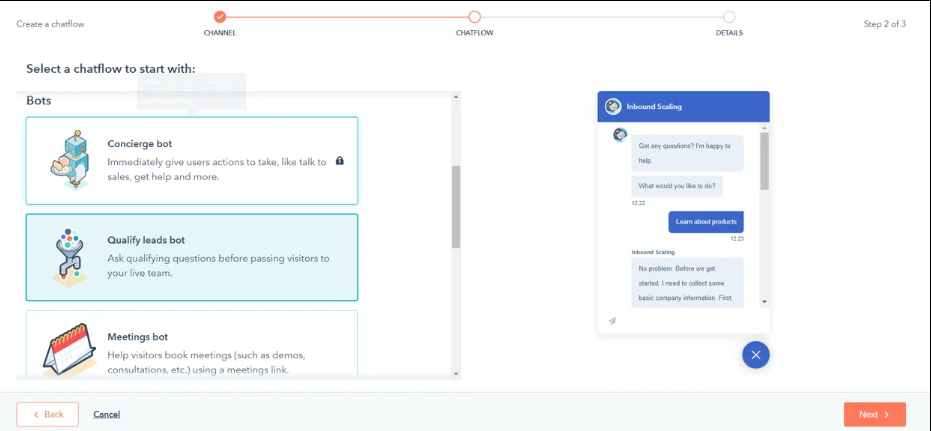
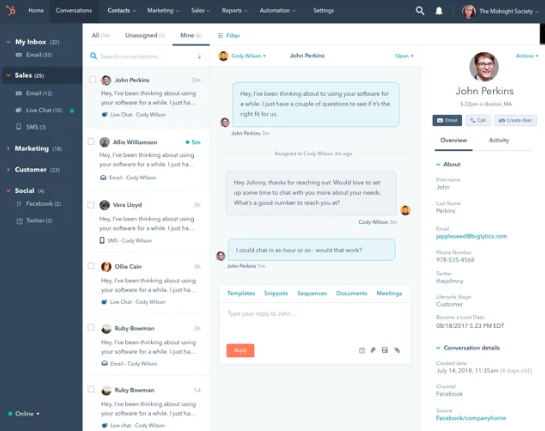
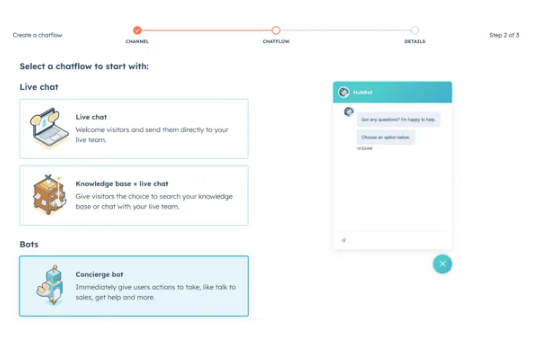
HubSpot’s chatbot is built into their comprehensive CRM platform, making it the natural choice for businesses already using HubSpot for marketing, sales, or service. The tight integration enables sophisticated automation tied directly to contact records and deal stages.
Key Features
CRM Automation: Every bot conversation automatically creates or updates contact records in HubSpot CRM with full conversation history.
Lead Capture & Qualification: Built-in qualification workflows collect contact information and score leads based on responses.
Email Integration: Conversations sync with email communications for complete contact history.
Meeting Scheduling: Integrates with HubSpot meetings tool to book sales calls automatically.
Knowledge Base Connection: Pulls answers from HubSpot knowledge base to resolve common questions.
Custom Workflows: Create sophisticated automation triggered by bot interactions, like sending follow-up emails or creating tasks.
Pros
- Completely free for basic chatbot features
- Seamless integration with HubSpot ecosystem
- No conversation volume limits on free plan
- Data automatically enriches CRM records
- Easy to build bots with visual editor
Cons
- Limited features compared to standalone chatbot platforms
- Requires HubSpot CRM (though that’s also free)
- Advanced automation requires paid HubSpot plans
- Not as AI-intelligent as specialized bots
Pricing
Free with HubSpot CRM. Advanced features require HubSpot Marketing Hub or Service Hub subscriptions starting at $800/month.
Best For
Businesses already using or planning to use HubSpot CRM. Perfect for companies wanting unified customer data across marketing, sales, and service without managing multiple tools.
Tool #7 – Ada
Overview
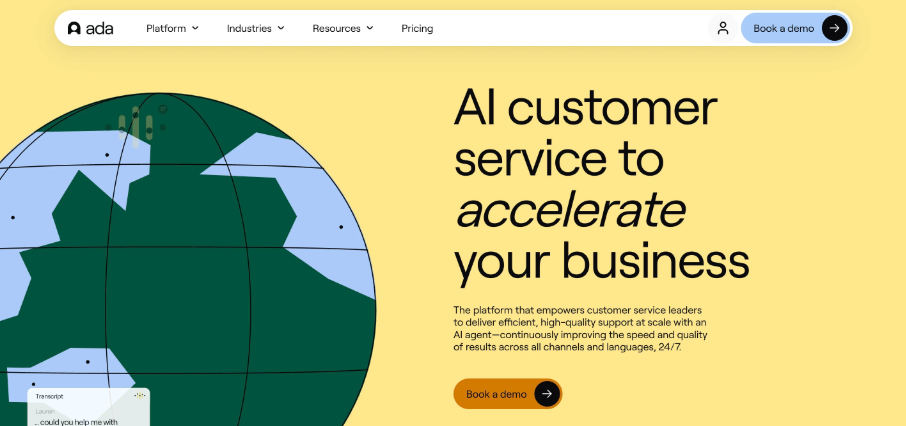
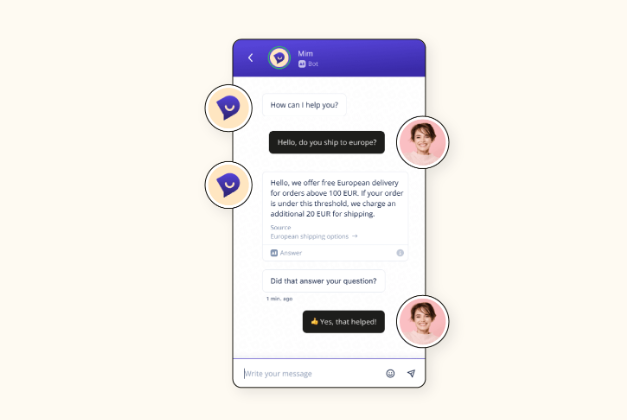
Ada is an enterprise-grade AI automation platform that powers customer service for major brands like Meta, Verizon, and Shopify. It specializes in deflecting support tickets through intelligent self-service while maintaining brand voice and quality.
Key Features
Enterprise Support Automation: Handles complex, multi-step support scenarios that traditional bots cannot manage.
Multilingual Chatbots: Supports over 50 languages with native-level conversation quality in each.
Self-Service Portal: Customers can resolve issues completely independently without agent involvement.
Advanced Analytics: Track deflection rates, resolution quality, customer satisfaction, and cost savings with detailed dashboards.
Personalization Engine: Adapts conversations based on customer history, segment, and context.
API-First Architecture: Integrates with any system through robust APIs and webhooks.
Pros
- Extremely sophisticated AI capable of handling complex scenarios
- Enterprise-grade security and compliance (SOC 2, GDPR, HIPAA)
- Proven to deflect 60-80% of support volume
- Excellent for brands with high support costs
- White-glove implementation and support
Cons
- Premium pricing limits it to enterprise budgets
- Requires dedicated implementation project
- Overkill for small businesses
- Custom pricing lacks transparency
Pricing
Custom pricing based on conversation volume, features, and support needs. Typically starts at $10,000+ annually.
Best For
Large enterprises and high-growth companies with substantial support volumes (10,000+ monthly inquiries). Ideal for brands prioritizing customer experience and willing to invest in premium automation.
Tool #8 – Freshchat
Overview
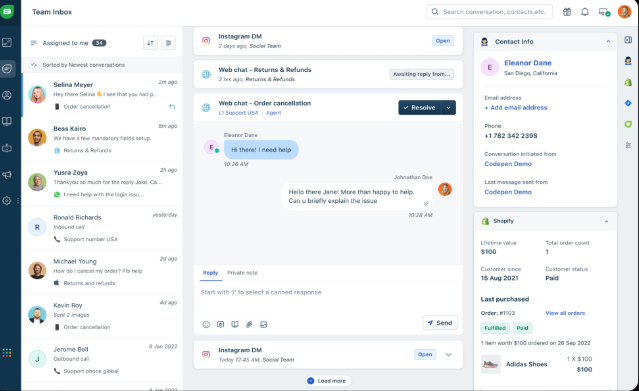
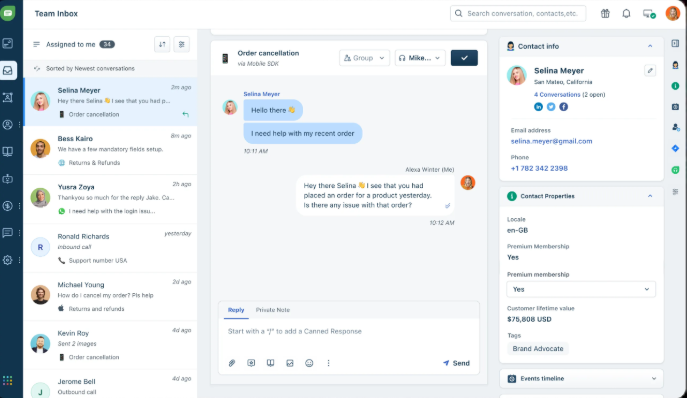
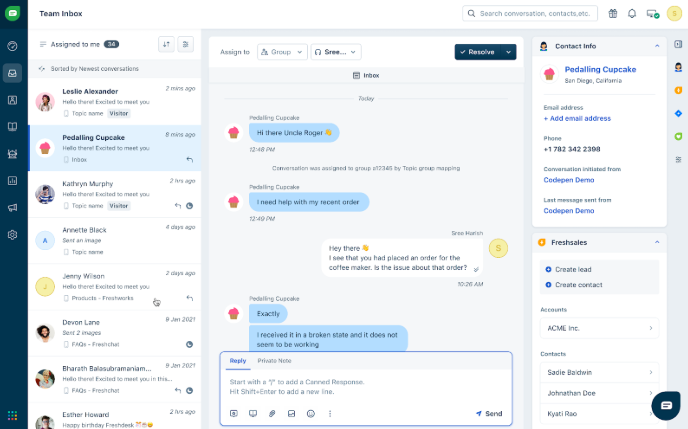
Freshchat, part of the Freshworks suite, delivers omnichannel messaging with AI-powered responses. It unifies conversations from website, mobile app, email, and social media into a single platform for support teams.
Key Features
Omnichannel Messaging: Customers can switch between channels mid-conversation without losing context.
AI Responses: Freddy AI suggests responses to agents and automatically answers common questions.
Automated Workflows: Route conversations, send proactive messages, and trigger actions based on customer behavior.
Team Collaboration: Internal notes, assignments, and conversation ownership keep teams coordinated.
Mobile SDKs: Embed chat directly into iOS and Android apps.
Conversational Marketing: Proactively engage visitors based on behavior patterns and page visits.
Pros
- Affordable for teams of all sizes
- Excellent omnichannel capabilities
- Clean, modern interface
- Strong mobile app experience
- Good integration with Freshdesk help desk
Cons
- AI capabilities less advanced than specialized platforms
- Some features require higher-tier plans
- Occasional learning curve for advanced features
- Limited customization options
Pricing
Free plan for up to 10 agents. Growth plan starts at $15/agent/month. Pro and Enterprise plans available with advanced features.
Best For
Support teams managing conversations across multiple channels who need unified visibility. Great for businesses using or considering Freshworks ecosystem tools.
Tool #9 – Landbot
Overview
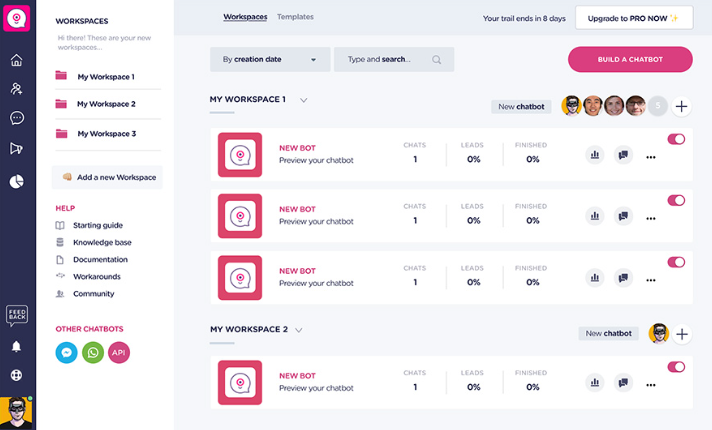
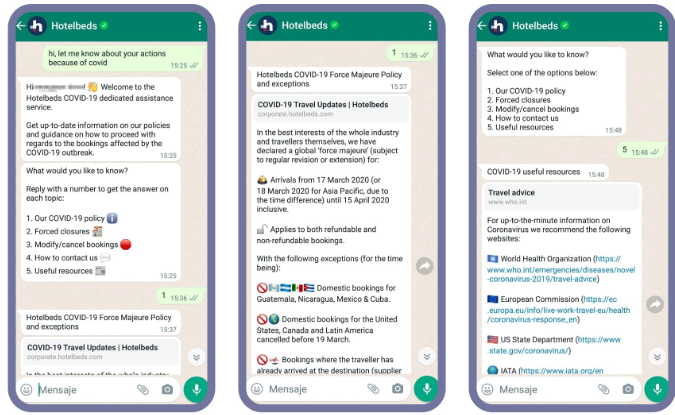
Landbot takes a unique approach by transforming traditional landing pages into interactive conversations. Instead of forms, visitors engage with chatbots that feel natural and increase completion rates significantly.
Key Features
Conversational Landing Pages: Replace static forms with engaging chat interfaces that convert up to 2x better.
No-Code Chatbot Builder: Visual builder creates sophisticated conversation flows without programming.
WhatsApp Automation: Build and deploy WhatsApp bots for customer service and marketing.
Lead Capture & Qualification: Interactive conversations collect more complete data than traditional forms.
Conditional Logic: Create branching conversations that adapt based on user responses.
Payment Integration: Accept payments directly within chat conversations through Stripe.
Pros
- Unique approach that significantly increases conversion rates
- Very user-friendly builder
- Strong WhatsApp integration
- Beautiful, modern conversation interfaces
- Good analytics and optimization tools
Cons
- More expensive than basic chatbot platforms
- Limited customer support capabilities
- Focused primarily on marketing use cases
- Learning curve for maximizing features
Pricing
Sandbox free plan for testing. Starter plan begins at $40/month. Pro and Business plans available for advanced features.
Best For
Marketing teams looking to increase landing page conversion rates, businesses running lead generation campaigns, and companies wanting to provide modern, engaging user experiences.
Tool #10 – Botpress
Overview
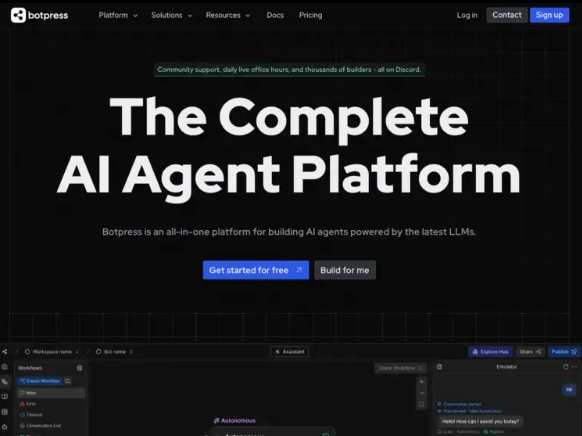
Botpress is an open-source, developer-friendly AI bot platform that gives technical teams complete control over bot behavior, integrations, and deployment. It’s designed for businesses that need custom solutions beyond what no-code platforms offer.
Key Features
Open-Source AI Bot Platform: Full access to source code enables unlimited customization.
Customizable AI Workflows: Build any conversation flow imaginable with complete programming control.
Developer Friendly: Native support for custom integrations, APIs, and complex business logic.
On-Premise Deployment: Host bots on your own infrastructure for maximum security and compliance.
NLU Training: Train natural language understanding models on your specific domain and terminology.
Channel Flexibility: Deploy the same bot across web, mobile, Slack, Teams, and any channel.
Pros
- Unlimited customization possibilities
- No vendor lock-in or platform restrictions
- Free for self-hosted deployments
- Active developer community
- Excellent documentation and tutorials
Cons
- Requires technical skills to maximize
- Steeper learning curve than no-code platforms
- Self-hosting adds infrastructure management
- Less hand-holding than managed solutions
Pricing
Open-source version completely free. Cloud-hosted plans start at $595/month for enterprise features and support.
Best For
Development teams building custom AI solutions, enterprises with strict security requirements, and businesses needing bots that integrate deeply with proprietary systems.
Tool #11 – ChatBot.com
Overview
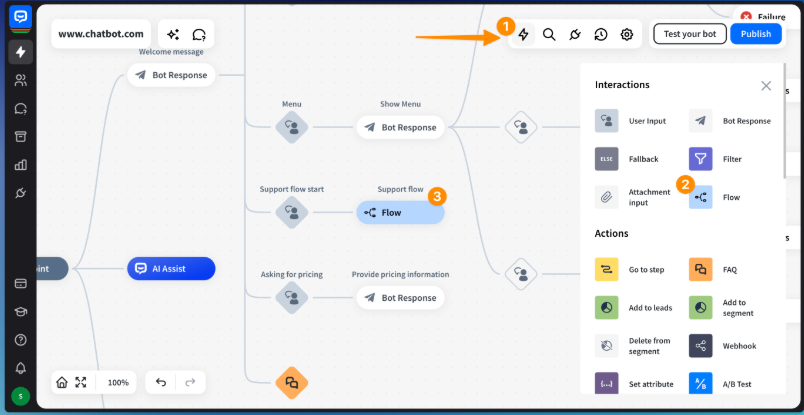
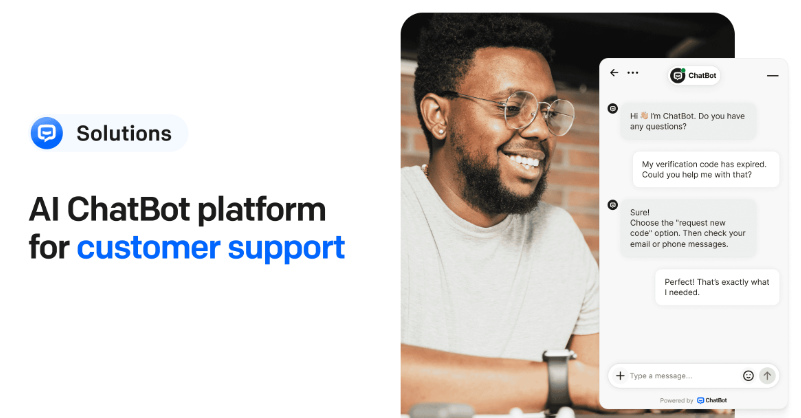
ChatBot.com focuses on sales automation and lead qualification through intelligent conversation design. It’s particularly effective for businesses that need to capture, qualify, and route leads efficiently without complex setup.
Key Features
Automated Customer Conversations: Pre-built templates handle common sales and support scenarios.
Lead Routing: Automatically assigns conversations to the right team member based on qualification criteria.
Sales Automation: Guides prospects through product selection, qualification, and scheduling.
Visual Builder: Drag-and-drop interface creates conversation flows without coding.
AI Training: Machine learning improves response accuracy over time.
Rich Media Support: Use images, videos, buttons, and cards to create engaging conversations.
Pros
- Focused on business outcomes (sales, leads)
- Reasonable pricing for included features
- Easy to use for non-technical teams
- Good template library
- Strong integration options
Cons
- AI capabilities less sophisticated than premium platforms
- Some advanced features require higher plans
- Learning curve for complex workflows
- Limited customization compared to developer platforms
Pricing
Starter plan at $52/month for basic features. Team plan at $142/month adds collaboration. Custom enterprise pricing available.
Best For
Small to medium businesses focused on lead generation and sales qualification. Ideal for companies wanting straightforward automation without overwhelming complexity.
AI chatbots can qualify leads, answer questions, and route high-intent customers to sales teams automatically—making tools like ChatBot.com valuable for revenue-focused businesses.
Benefits of Using AI Bots for Business
The value of AI bots extends far beyond simple automation. Businesses implementing these tools experience transformative improvements across multiple dimensions.
Increased Productivity
AI bots handle the repetitive, time-consuming tasks that drain human productivity. Support agents no longer spend hours answering the same questions repeatedly. Sales teams stop chasing unqualified leads. Marketing teams avoid manual data entry.
This freed capacity allows human team members to focus on high-value activities: solving complex customer problems, closing high-stakes deals, and building strategic initiatives.
Faster Customer Response
Response speed directly correlates with customer satisfaction and conversion rates. AI bots respond in seconds, not hours or days. This immediacy meets modern customer expectations and prevents leads from going cold.
Studies show that responding to a web lead within 5 minutes makes you 9x more likely to convert them than waiting 30 minutes. AI bots respond instantly, every time.
Higher Lead Conversion
AI sales bots qualify leads automatically, asking the right questions to identify buying intent and budget. They engage visitors at the perfect moment—when interest is highest—and guide them through decision-making.
This proactive engagement captures leads that would otherwise bounce. The result is higher conversion rates across the funnel.
Reduced Support Costs
The most tangible benefit is cost reduction. AI bots resolve 60-80% of common inquiries without human involvement. This dramatically reduces the number of support agents needed to maintain service levels.
A support team that previously needed 15 agents might operate effectively with 5-6 agents after implementing AI automation—saving $300,000-400,000 annually while maintaining or improving response times.
Personalized Customer Experience
Modern AI bots access customer history, purchase data, and behavioral patterns to deliver personalized experiences. They remember previous conversations, reference past purchases, and tailor recommendations to individual preferences.
This personalization creates better customer experiences than generic, one-size-fits-all interactions—leading to higher satisfaction and loyalty.
Scalability Without Limits
Perhaps the most powerful benefit is unlimited scalability. AI bots can handle 1 conversation or 10,000 simultaneous conversations with identical quality and speed. As your business grows, your support capacity grows automatically without proportional cost increases.
This scalability enables businesses to handle seasonal spikes, viral marketing campaigns, and rapid growth without scrambling to hire and train new agents.
The combined impact of these benefits creates a competitive advantage that’s difficult for businesses relying solely on human-powered operations to match.
AI Bots Use Cases in Different Industries
AI bots adapt to virtually any industry’s unique needs. Here’s how different sectors leverage automation:
E-commerce
Online retail benefits enormously from AI automation:
Order Tracking: Customers check order status instantly without contacting support—reducing ticket volume by 40-50%.
Product Recommendations: AI analyzes browsing history and preferences to suggest relevant products, increasing average order value.
Abandoned Cart Recovery: Automated messages to shoppers who left items in cart recover 10-15% of abandoned sales.
Size and Fit Guidance: Bots help customers choose correct sizes, reducing return rates.
Returns and Refunds: Automate return authorization and refund processing for eligible orders.
SaaS and Technology
Software companies use AI bots extensively:
User Onboarding: Guide new users through setup, reducing time-to-value and improving activation rates.
Technical Support Tickets: Resolve common technical issues with troubleshooting workflows before creating tickets.
Feature Education: Proactively teach users about features they’re not utilizing.
Subscription Management: Handle plan upgrades, billing questions, and account changes automatically.
Product Feedback Collection: Gather user feedback systematically to inform product roadmap.
Healthcare
Medical practices and health tech companies deploy bots for:
Appointment Booking: Patients schedule, reschedule, and cancel appointments 24/7 without phone calls.
Symptom Checking: Pre-screen patients and triage based on symptom severity.
Prescription Refills: Automate prescription renewal requests and routing to appropriate staff.
Insurance Verification: Collect and verify insurance information before appointments.
Follow-up Care: Send automated post-visit check-ins and care instructions.
Finance and Banking
Financial institutions leverage AI for:
Account Inquiries: Check balances, recent transactions, and account status instantly.
Fraud Alerts: Proactively notify customers of suspicious activity and verify legitimacy.
Loan Applications: Collect initial application information and provide instant pre-qualification.
Investment Guidance: Answer common questions about products, fees, and processes.
Automated FAQs: Handle routine questions about operating hours, locations, and services.
Real Estate
Property businesses use bots to:
Lead Qualification: Determine buyer/renter budget, timeline, and preferences automatically.
Property Information: Answer questions about listings, neighborhoods, and availability.
Tour Scheduling: Book property viewings based on agent availability.
Document Collection: Gather required documentation from prospects systematically.
The versatility of AI bots means virtually any customer-facing industry can benefit from intelligent automation tailored to their specific workflows and customer needs.
How to Choose the Right AI Bot for Your Business
Selecting the perfect AI bot requires evaluating your specific situation. Follow this framework:
1. Assess Business Size and Resources
Small businesses (1-10 employees): Choose affordable, easy-to-use platforms like Tidio, ManyChat, or HubSpot’s free chatbot. Avoid complex enterprise solutions.
Mid-sized businesses (10-100 employees): Consider platforms like Intercom, Freshchat, or ChatBot.com that balance features with reasonable pricing.
Enterprise (100+ employees): Evaluate sophisticated platforms like Ada, Drift (for sales), or Botpress (for custom needs) that can handle scale and complexity.
2. Define Automation Needs
Support-focused: Prioritize platforms strong in ticket deflection and knowledge base integration (Intercom, Ada, Freshchat).
Sales-focused: Choose tools built for lead capture and qualification (Drift, ChatBot.com, HubSpot).
Marketing-focused: Select social media specialists (ManyChat, Chatfuel) or conversational landing page tools (Landbot).
Multi-purpose: Look for versatile platforms that handle multiple use cases (Intercom, HubSpot).
3. Evaluate Integration Requirements
List tools your business already uses:
- CRM (Salesforce, HubSpot, Pipedrive)
- Help desk (Zendesk, Freshdesk, Jira)
- E-commerce (Shopify, WooCommerce, BigCommerce)
- Marketing (Mailchimp, ActiveCampaign)
Choose a bot platform with native integrations or strong API support for your existing stack. Avoid creating data silos.
4. Set Realistic Budget
Free/Low-cost ($0-50/month): HubSpot, Tidio free plan, ManyChat, Chatfuel Mid-range ($50-500/month): Tidio paid, Landbot, ChatBot.com, Freshchat Premium ($500-2,500/month): Intercom, Botpress cloud Enterprise ($2,500+/month): Drift, Ada, custom solutions
Remember that cost should be evaluated against value delivered. A $2,500/month tool that reduces support costs by $8,000/month is a bargain.
5. Consider Channel Requirements
Where do your customers interact with you?
Website only: Any platform works Website + social media: ManyChat, Chatfuel, Intercom Website + WhatsApp: Landbot, Intercom Omnichannel (website, email, social, SMS): Freshchat, Intercom Voice + chat: Consider platforms with voice AI or telephony integration
Match the platform’s channel support to where your customers actually are.
Testing and Implementation
Once you’ve narrowed choices to 2-3 platforms:
- Start free trials simultaneously: Most platforms offer 7-14 day trials
- Build identical test flows: Create the same bot on each platform to compare
- Involve your team: Get feedback from people who’ll use the tool daily
- Test customer experience: Have real customers interact and provide feedback
- Evaluate analytics: Compare reporting quality and insights provided
The right AI bot should feel intuitive to build, provide valuable data, and demonstrably improve business metrics.
Common Mistakes Businesses Make with AI Bots
Even powerful AI tools can fail when implemented poorly. Avoid these frequent errors:
Using Generic Scripts
Many businesses deploy bots with default templates and generic responses. Customers immediately recognize impersonal, robotic interactions.
Fix: Customize conversation flows to match your brand voice, products, and customer questions. Include specific details only your company would know.
No Human Escalation
Bots that trap customers in endless loops without escape frustrate users and damage brand reputation. Some questions genuinely require human expertise.
Fix: Always provide clear escalation paths. Include “speak to a human” options and automatically escalate when the bot can’t resolve an issue after 2-3 attempts.
Poor Training Data
AI bots are only as good as the data they’re trained on. Insufficient knowledge base content or inaccurate information leads to wrong answers.
Fix: Invest time building comprehensive knowledge bases. Review bot conversations regularly and update training data based on questions it struggles with.
Ignoring Analytics
Many businesses set up bots and never review performance data. This wastes improvement opportunities.
Fix: Review bot analytics weekly. Identify conversation breakdowns, common questions, and improvement opportunities. Continuously optimize flows based on real usage data.
Over-Automation
Some companies try to automate everything, including complex scenarios better handled by humans. This frustrates customers and creates poor experiences.
Fix: Automate routine, high-volume tasks. Keep humans involved in complex sales, sensitive issues, and high-value interactions.
Neglecting Updates
Products change, policies evolve, and seasonal questions shift. Bots quickly become outdated without maintenance.
Fix: Schedule monthly bot reviews. Update responses when products, pricing, or policies change. Adjust seasonal messaging proactively.
Avoiding these mistakes dramatically increases the likelihood of successful AI bot implementation that customers appreciate rather than tolerate.
Future of AI Bots for Business
AI automation is evolving rapidly. Here’s what’s coming:
AI Agents Replacing Support Teams
The next generation of AI agents can handle increasingly complex scenarios that currently require human agents. Advanced language models understand nuance, emotion, and context at near-human levels.
Within 2-3 years, AI will handle 90%+ of routine support interactions, with humans focusing exclusively on edge cases and relationship building.
Voice AI Assistants
Voice-based AI is advancing rapidly. Businesses will deploy voice bots that sound completely natural, handling phone inquiries without caller awareness they’re speaking with AI.
This extends automation beyond text into the massive volume of phone-based customer service.
Autonomous Business Agents
Beyond customer-facing roles, AI agents will handle internal business processes: scheduling meetings, updating CRM records, generating reports, and coordinating between systems—all without human intervention.
AI-Driven Personalization
Future bots will leverage comprehensive customer data to deliver hyper-personalized experiences. Every interaction will feel custom-tailored to individual preferences, history, and context.
This level of personalization will exceed what human agents can practically deliver at scale.
Proactive Problem Solving
Instead of waiting for customers to reach out, AI will proactively identify issues and solve them before customers notice. Imagine your subscription renewing but payment failing—AI detects this, updates payment method using saved information, and confirms everything is handled before you realize there was an issue.
Many companies are now integrating AI agents directly into enterprise workflows to automate support and operational tasks, transforming how businesses operate fundamentally.
The trajectory is clear: AI bots are becoming more capable, more natural, and more integrated into every business process. Companies that embrace this evolution will operate with unprecedented efficiency and customer satisfaction.
Conclusion
AI bots for business have evolved from experimental novelties to essential operational tools. They automate sales conversations, resolve support tickets, qualify leads, and provide 24/7 customer assistance—all while reducing costs and improving satisfaction.
The 11 tools reviewed in this guide each excel in different scenarios:
For small businesses on a budget: Tidio offers excellent value with AI automation, live chat, and e-commerce features at affordable pricing. HubSpot’s free chatbot is also excellent for businesses already using their CRM.
For marketing and social media: ManyChat and Chatfuel dominate Facebook and Instagram automation, perfect for businesses building audiences on social platforms.
For sales acceleration: Drift remains the premium choice for B2B companies focused on lead generation and revenue. The investment pays for itself through increased conversion rates and faster sales cycles.
For comprehensive customer support: Intercom provides the most complete platform, combining AI automation with help desk, live chat, and customer data tools.
For enterprise-level automation: Ada delivers sophisticated AI capable of handling complex support scenarios at scale, ideal for large organizations with substantial support volumes.
For developers and custom solutions: Botpress offers unlimited flexibility for technical teams building specialized AI applications.
The right choice depends on your specific needs: business size, budget, primary use case, and technical resources. Most platforms offer free trials—test 2-3 options before committing.
Remember that implementing AI bots is not a “set and forget” project. Success requires ongoing optimization, regular updates, and continuous improvement based on performance data.
The competitive advantage goes to businesses that implement AI automation thoughtfully, customize it to their unique situations, and maintain quality as they scale.
Start with one clear use case—perhaps automating FAQ responses or capturing website leads—prove value, then expand from there. Even modest automation delivers measurable improvements in efficiency, cost, and customer satisfaction.
The future of business operations is AI-assisted. The question is not whether to adopt AI bots, but how quickly you can implement them effectively to stay competitive in 2026 and beyond.
Choose the tool that fits your business goals, and start automating today.
